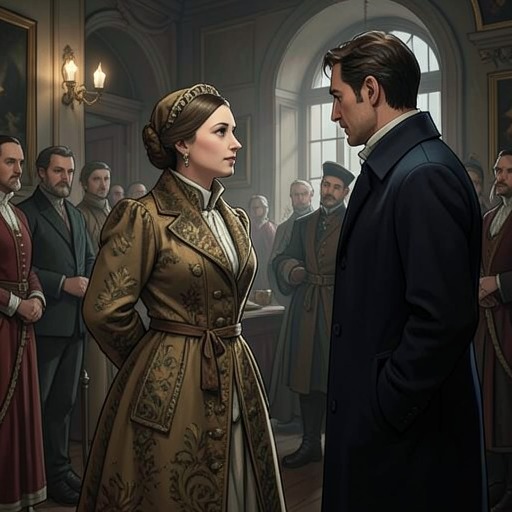
Jean-Joachim Goriot
Père GoriotJean-Joachim Goriot is a retired vermicelli manufacturer whose gradual impoverishment reveals the cost of paternal devotion in a society governed by money and status. Once a prosperous and capable trader, he spends his wealth making life splendid for his daughters, then retreats to the Maison Vauquer when their marriages separate him from them. His transformation from respected, well-dressed bourgeois to mocked and visibly aged lodger makes private sacrifice a measure of public indifference.
Identity and Background
Before retiring, Goriot had made his living in the grain and pasta trade. Before the Revolution, he was a workman employed by a vermicelli maker; when the disturbances of 1789 offered an opportunity to acquire the business, he bought it and established himself near the Corn Exchange. His practical judgment helped protect and grow the enterprise. During the period of scarcity, when grain prices rose sharply and people struggled for bread, he profited by selling Italian paste foods and applying his detailed knowledge of grain, storage, and markets.
Goriot was neither a political visionary nor an exceptional speculator. His success came from careful commercial expertise, sound judgment, and a degree of unremarkable respectability that kept others from suspecting his wealth until its most dangerous period had passed. He knew the production and quality of grain, could estimate harvest yields and anticipate prices, and bought cereals in Sicily and Russian wheat for import. The story’s account of this business acumen sets up a sharp contrast: a man able to calculate markets with precision would become helpless in the emotional economy of his family.
In 1813, at about sixty-nine, Goriot sold his business and entered the Maison Vauquer. His first rooms were among the best in the house, and he paid twelve hundred francs a year, treating the expense as minor. He arrived with the wardrobe and possessions of a prosperous retired tradesman: eighteen fine shirts, diamond shirt pins joined by a short chain, a blue coat, a white waistcoat, a gold chain and seals, and a quantity of plate. When his hostess remarked on his fondness for fine dress, he accepted the observation with a citizen’s vanity. The household initially addressed him respectfully as Monsieur Goriot.
Fatherhood and the Loss of His Fortune
Goriot’s daughters, Anastasie and Delphine, were the center of his life. Even with an income of sixty thousand francs, he spent scarcely twelve hundred francs on himself and directed his resources toward satisfying their wishes. He hired the best teachers, arranged for them to learn accomplishments and riding, provided them with a carriage, and gave them the life of the daughters of a wealthy man. He asked little in return beyond their affection. His generosity was so complete that he raised them as if they were angels, while placing himself beneath them; he continued to love them even when that love brought him pain.
When the daughters married, each received half his fortune as a dowry. Anastasie married the Comte de Restaud, whose suit answered her desire for a more elevated social position. Delphine married Nucingen, a banker who became a baron, seeking the money and standing associated with his position. Goriot remained attached to the trade that had sustained him. His daughters and sons-in-law disliked his continuing to work, and for five years he resisted their pressure to retire. He finally gave in, living on the proceeds of the business sale and his remaining savings.
The money that had been intended to secure his daughters’ happiness did not secure a place for him in their households. Their husbands compelled them not only to refuse to take him in, but even to see him only in private. Goriot took refuge in the boarding house, despite having expected that his daughters’ homes would become homes for him as well, where he would be loved and valued. The contrast between that hope and his actual exclusion defines the tragedy of his devotion: he gives his wealth to make their lives, then finds himself treated as an unwelcome presence in them.
Decline at the Maison Vauquer
The decline was visible in the lodgings and in Goriot’s body. At first he occupied three rooms and paid the price of a man for whom a few extra louis made little difference. By the end of his third year at the house, he had reduced his expenses again, moved up to the third floor, and was paying forty-five francs a month. He gave up snuff, dismissed his hairdresser, and stopped wearing powder. His former finery disappeared piece by piece: the fine linen was replaced with inexpensive calico, and his diamonds, gold snuff-box, watch-chain, and other ornaments were gone. The blue coat gave way to a coarse brown one, with a plush waistcoat and doeskin breeches.
The change prompted speculation and contempt. When Goriot appeared with olive-gray hair, Mme. Vauquer and the other boarders treated his altered appearance as evidence that he had been an elderly libertine, and attributed the discoloration to excess and medicines. The narrative presents that explanation as part of the absurd talk his physical decline encouraged, not as a reliable account of his past. His thinning frame, sunken cheeks, wrinkles, and furrowed forehead instead mark the speed and severity of his deterioration. Within four years of arriving in the Rue Neuve-Sainte-Geneviève, the once-portly tradesman had become a feeble, vacillating old man.
At the boarding house, Goriot becomes the object of the other lodgers’ jokes and half-malignant contempt. At the beginning of Rastignac’s second year there, the retired merchant comes into focus as the gathering’s despised figure, a subject on whom the story directs its light. The lodgers’ routine brings them together, but not into sympathy: they can pass suffering without pity, and regard death as a solution to misery. Their treatment of Goriot shows how readily helplessness invites abuse. His endurance and humility do not protect him; they help make him an easy target.
Relationships and Recognition
Rastignac’s growing interest in Goriot leads him to seek the old man’s history. The Viscountess de Beauséant explains the scale of his sacrifice: he reportedly gave each daughter five or six hundred thousand francs to marry well, while keeping only eight or ten thousand livres a year for himself. He had imagined that his daughters would remain his daughters and that their homes would offer him affection and respect. Instead, within two years, both sons-in-law had driven him away as though he were an outcast. The account gives Rastignac, newly arrived in Paris, a first encounter with the gap between his inherited beliefs and the city’s ordinary conduct.
Goriot’s tenderness is not limited to financial provision. His love makes him anxious for his daughters, and the story shows how easily that anxiety can be exploited. A competitor once falsely told him that Delphine had been struck by a cab. Goriot turned pale, left the Corn Exchange immediately, and was ill for several days from the shock and the subsequent relief when he learned she was safe. The person who had played on his fear was later driven into bankruptcy by Goriot at a critical moment in his affairs. The episode reveals both the vulnerability created by his attachment and the force he could still exercise when he chose to defend his commercial interests.
The daughters’ estrangement also reflects the pressures of marriage and status, though it does not erase their responsibility for his abandonment. Goriot’s sons-in-law control whether they receive him, while the daughters’ elevated households stand in place of the family life he had imagined. His hopes are therefore defeated through the very marriages and social advancement for which he gave away his fortune. The generosity that helped them rise leaves him with diminishing means and no secure claim on their companionship.
Narrative Role and Significance
Goriot’s story turns the boarding house into a small social world in which the treatment of its poorest and most vulnerable resident exposes the conduct of the whole. Its eighteen dinner companions form a society in miniature, yet its daily proximity produces neither solidarity nor compassion. Goriot’s humiliation is not simply a private misfortune: it gives the narrative a way to examine how people use money, rank, and another person’s endurance, and how readily visible decline becomes material for ridicule.
His life also binds two periods of social change. The fortune that once set him above small buyers was built amid revolutionary scarcity and commercial opportunity; the same fortune is later divided to advance his daughters’ marriages and disappears from his control. His business knowledge could secure grain and anticipate markets, but it could not make family affection reciprocal. In this contrast lies the defining irony of his character: Goriot understands value in trade, yet measures love by what he gives, not by what he receives.
The repeated descent—from spacious rooms to a cheap room on the third floor, from diamond pins and fine linen to a coarse coat and calico, from household respect to public mockery—gives his decline a material form. Each reduction records the conversion of paternal devotion into personal loss. Goriot remains attached to the daughters for whom he has sacrificed his independence, while those sacrifices help explain why his suffering becomes so stark: he has given them not only money, but the place in his own life that he might otherwise have claimed for himself.